The “Stoplight” Self-Tape Method: A Calm Way to Adjust Your Performance Without Starting Over
If you keep restarting your self-tape every time something feels “off,” this simple stoplight method helps you adjust in real time and stay in the scene. A practical way to get usable takes faster—without spiraling.
If you self-tape long enough, you’ll hit this loop:
You do a take. It’s… fine. Then your brain goes, “Wait, my pace was weird.”
You restart.
Halfway through you think, “That beat felt false.”
You restart.
Now you’re not acting anymore—you’re hunting. You’re trying to control the scene instead of playing it.
Here’s a tool that’s saved me on days when the clock is loud, the sides are tricky, and my nervous system wants to micromanage everything:
The Stoplight Method.
It’s not a performance technique in the fancy sense. It’s a decision-making tool—so you can adjust without burning an hour doing twelve near-identical takes.
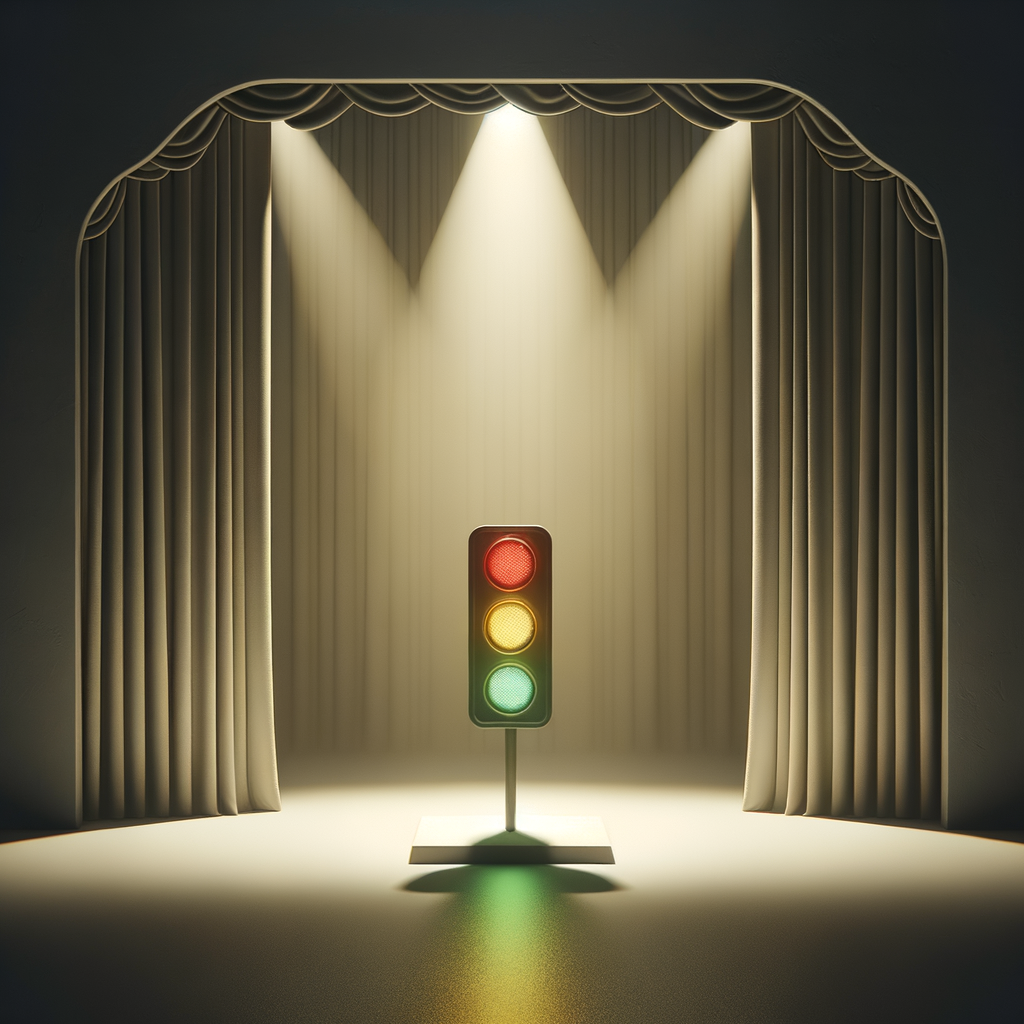
The Stoplight Method (Green / Yellow / Red) Think of each moment that bothers you in playback as one of three categories:
- **Green:** Keep it. Don’t touch it.
- **Yellow:** Adjust it—slightly—next take.
- **Red:** Fix it before you roll again (it’s breaking the tape).
The point is to stop treating every note like it’s a crisis.
Most “problems” in self-tapes are Yellow. But we treat them like Red, and that’s where the time (and confidence) disappears.
The goal isn’t a flawless take. It’s a bookable take that reads clearly and feels human.
Step 1: Define what counts as RED Red issues are the ones that make casting stop watching—or stop understanding what’s happening.
Common Reds:
- **You can’t hear you.** Audio is peaking, muffled, or the reader is louder than you.
- **You’re consistently off-eye-line.** It looks like you’re talking to the camera or searching for the person.
- **The scene becomes confusing.** You’re stepping on important story info or the beats are scrambled.
- **Your reader’s timing is wrecking you.** Too fast, too slow, or they’re paraphrasing and it’s throwing your cues.
- **You’re visibly outside the scene.** You’re apologizing, laughing, breaking, or showing frustration.
If it’s Red, you stop and fix it before another take. Otherwise you’re just collecting unusable footage.
Practical Red fixes:
- Move the mic/phone closer, lower reader volume, or get off Bluetooth if it’s lagging.
- Tape a small mark near your eyeline (or put the reader on a chair/stand) so it’s consistent.
- Ask your reader for one simple change: “Hold me a half beat before your last line,” or “Can you stay neutral and let me drive?”
Step 2: Learn to love YELLOW (that’s where your bookings live) Yellow is anything that’s “not perfect” but absolutely workable.
Common Yellows:
- Your pace was a little quick in the first third.
- One line sounded “actor-y.”
- You pushed an emotional moment a hair.
- A transition didn’t land as clearly as you wanted.
- You want a slightly different intention on one beat.
Here’s the key: **Yellow gets one adjustment at a time.**
Not five. Not a full reset. Not a brand new concept.
Pick **one** Yellow note for the next take. That’s it.
Examples of good Yellow adjustments:
- “Same take, but breathe before the reveal line.”
- “Same take, but I’m listening longer after their accusation.”
- “Same take, but I’m warmer on the entrance.”
- “Same take, but I don’t explain the last button—I let it sit.”
This keeps you in the same world, which is what casting needs: consistency and clarity.
Step 3: Protect GREEN like it’s your job (because it is) Green is everything that already works. And most actors accidentally erase it.
Maybe the first take had:
- real spontaneity
- grounded listening
- a great button
- a natural physical life
…then we restart and chase “clean,” and we end up with a perfectly executed version that’s dead behind the eyes.
So when you watch playback, actively label Greens:
- “That entrance is Green.”
- “That laugh is Green.”
- “That pause before I answer is Green.”
Then your job is to **keep those moments** while you tweak one Yellow.
Don’t rebuild a house because you want to repaint one wall.
The 90-Second Playback Rule (so you don’t spiral) Playback can be helpful or it can become self-sabotage. Here’s a limit that keeps it useful:
- Watch your take **once** for story clarity.
- Take **90 seconds** to label Green/Yellow/Red.
- Make a decision.
- Roll again.
If you keep watching, you’ll start “auditioning for yourself” instead of for the role.
A nice trick: write down your one Yellow adjustment in five words or less.
Examples:
- “Slow down on apology.”
- “Let them win that beat.”
- “Drop the sarcasm on line 3.”
- “Hold eye-line on the threat.”
If you can’t summarize the note simply, it’s probably not a note—it’s anxiety.
How this helps when you’re working with a reader Self-tapes get exponentially easier when your reader knows what you’re trying to do. But they don’t need a dissertation.
Use the stoplight language with them. It’s fast, non-dramatic, and collaborative.
Try:
- “That last take was mostly Green. One Yellow: can you give me a little more space after your second line?”
- “Quick Red: I’m losing you on the cue—can you stick to the punctuation?”
- “Everything’s Green. Let’s keep it and just do one for safety.”
This is especially useful with a strong reader because it keeps the focus on **your** adjustments, not reinventing the whole scene.
A sample workflow (what it looks like in real life) Let’s say you tape twice.
**Take 1:** You feel alive, but you rushed the big reveal and your last line got mushy.
- Green: entrance, listening, middle beat
- Yellow: reveal pace
- Yellow: last line clarity
Choose one Yellow. Next take: **reveal pace**.
**Take 2:** Reveal lands. Last line is still a little unclear.
Now decide:
- If the last line is **Red** (story is confusing), fix it and do one more.
- If it’s **Yellow** (you just wish it were cleaner), you can stop if the tape feels bookable.
That’s the whole thing: clear decisions, fewer emotional resets.
When to stop (a practical benchmark) You’re done when:
- There are no Reds.
- Your best take has mostly Greens.
- The remaining Yellows are preferences, not problems.
If you keep going after that, you’re usually trading specificity for control—and control reads as tension.
Final thought: self-taping is mostly nervous system management Actors love to blame their setup, their camera, the lighting, the room, the neighbor’s dog.
Sometimes those are real. But often the real issue is that we’re treating the self-tape like a test we can fail.
The stoplight method makes it feel like work you can do.
One Red fix. One Yellow adjustment. Protect your Greens.
Then send it.
Because the casting office isn’t looking for the actor who never has a weird take.
They’re looking for the actor who can stay present, make clear choices, and keep going—like they would on set.