Self Tape Reader vs AI: Which Should You Use?
AI reader apps are everywhere now. But can they actually replace a human scene partner? Here's an honest comparison of when AI works, when it doesn't, and what casting directors actually think.
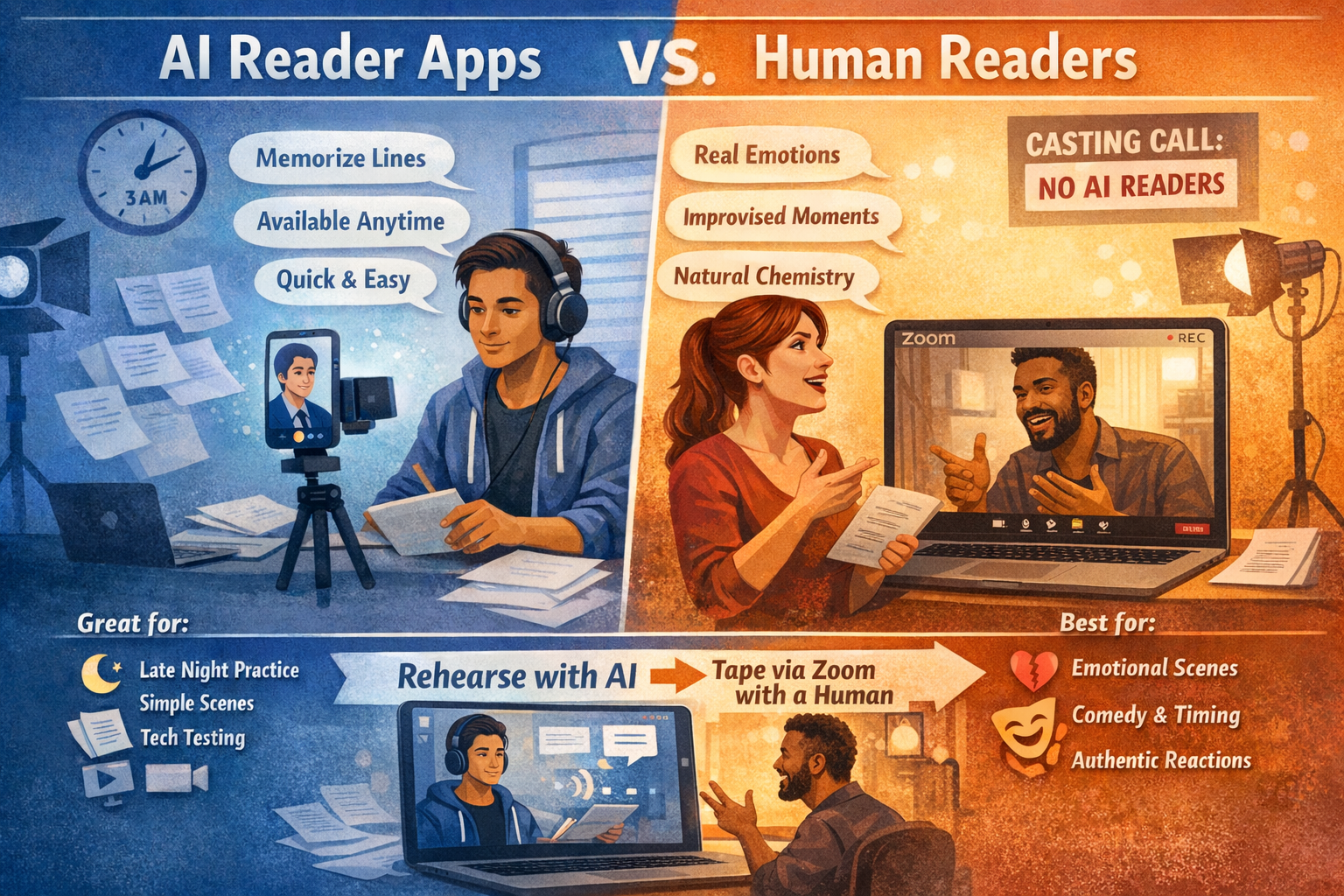
AI reader apps have gotten surprisingly good. You upload your sides, pick a voice, and the app reads the other character's lines while you perform.
It sounds perfect. No scheduling. No favors. No cost (or minimal cost). Available at 3am when you finally have time to tape.
So why are so many actors still booking human readers?
Acting is reacting. And it's really hard to react authentically to a robot.
Let's break down when AI works, when it fails, and how to decide which to use.
What AI Readers Do Well
Line memorization and rehearsal
This is where AI shines. When you're first learning your lines and need to run them 15 times, an AI reader is perfect. It's patient. It's consistent. It never gets tired or annoyed.
Tight deadlines with zero options
It's 11pm. Your tape is due at 9am. Nobody's awake. An AI reader is infinitely better than reading your own lines and editing them in — which casting directors universally hate.
Simple, short scenes
For a quick co-star audition with minimal emotional complexity, AI can work fine. If it's three lines about confirming a dinner reservation, you probably don't need a trained actor opposite you.
Consistency for technical setups
If you're testing your lighting, framing, or audio levels, an AI reader lets you run takes without wearing out a human scene partner.
Where AI Readers Fall Short
Emotional scenes
This is the big one. If your scene involves grief, rage, intimacy, or any real emotional stakes, you need something to react to. AI can't give you that.
A human reader who's engaged in the scene — even minimally — gives you eye contact, subtle reactions, and energy to play off. Your performance will be more alive.
Scenes with interruptions or overlapping dialogue
Most AI readers work on a cue system — they wait for you to finish, then speak. Real conversations don't work that way. If the scene requires interrupting, talking over each other, or unusual pacing, AI struggles.
Comedy and timing
Comedy is all about timing and surprise. An AI reader delivers lines the same way every time. A human reader can play with you, adjust timing, and help you find the funny.
When casting specifically says "no AI"
This is becoming more common. Some casting breakdowns now explicitly state: "No AI readers. We can tell."
Whether or not they actually can tell is debatable. But if they've asked for no AI, don't risk it.
What Casting Directors Actually Think
Most casting directors won't reject a tape just because you used an AI reader — if the performance is good.
But here's what they notice:
- Unnatural pauses between lines
- The actor "waiting" for their cue instead of listening
- A lack of connection or chemistry in emotional scenes
- Robotic vocal quality from the reader that distracts from the actor
A great performance can overcome a mediocre reader. But why handicap yourself?
The Hybrid Approach
Smart actors use both.
Step 1: Rehearse with AI
Run your lines with an AI reader until you're fully memorized and have made your character choices. This might be 10, 20, even 30 takes.
Step 2: Tape with a human
Once you're ready to record your actual submission, book a human reader. You'll be so prepared that the session will be quick and efficient — and your tape will have real energy.
This approach gives you the convenience of AI with the quality of a human reader.
The Math
Let's say you have 8 auditions this month.
- 4 are quick co-star auditions with simple scenes → AI reader is fine
- 3 are bigger roles with emotional content → book a human reader ($25-40 each)
- 1 is a major opportunity → book a reader or coach ($40-100)
Total spent: roughly $115-220 for the month.
That's less than most actors spend on coffee. And it directly impacts your bookings.
The Bottom Line
AI readers are a tool. A useful one. But they're not a replacement for human connection in scenes that require it.
Use AI for practice and simple scenes. Use humans when the performance matters.
Your tape is your audition. It's the only thing standing between you and the callback. Give yourself every advantage.