Same-Day Auditions: A Self-Tape Survival Guide (Without Losing Your Mind)
Got a self-tape due tonight? Here’s a practical, actor-to-actor plan for getting it done fast without sacrificing your best work—or your sanity.
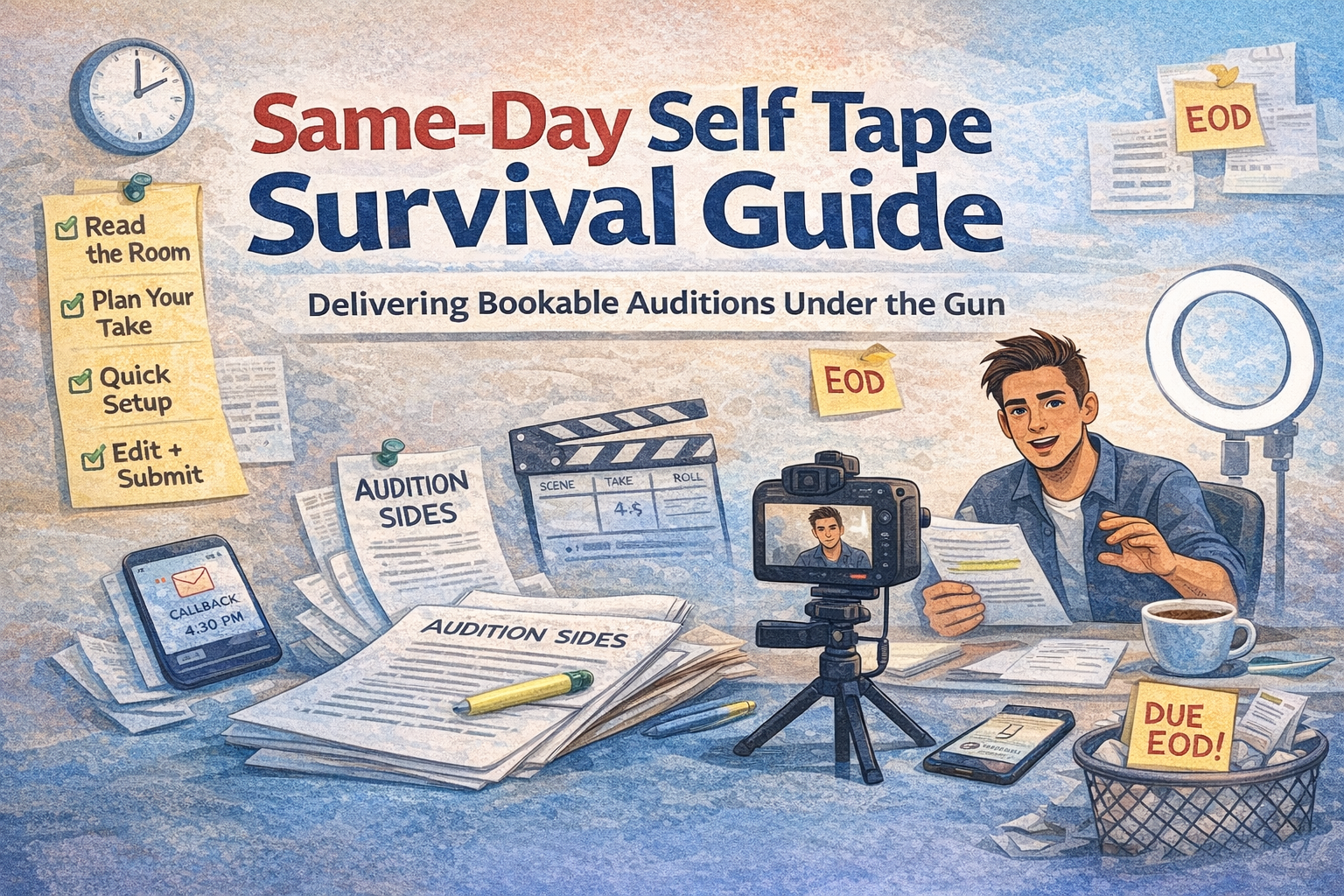
Same-day auditions used to send me into a spiral: frantic memorizing, random lighting, ten takes too many, and then a late-night upload panic. If you’re staring at a self-tape request due in a few hours, you don’t need perfection—you need a clean, bookable tape delivered on time.
Below is my working-actor survival system. Steal it, tweak it, and keep it in your back pocket for the next “Due EOD” email.
Step 1: Read the room (aka the breakdown + sides) in 10 minutes Your first job is to get oriented, not to “act” yet. Set a timer.
- Read the casting notes first (frame, slate, accents, props, wardrobe requests).
- Scan the breakdown for tone and world (comedy? grounded drama? high-status corporate?).
- Read the sides once without judging yourself.
Then ask two questions: - What does this character want in each beat? - What’s the relationship dynamic (power, intimacy, history)?
A same-day tape isn’t about showing everything you can do. It’s about showing you understand the assignment.
Step 2: Decide your “one clear take” concept You do not have time for five versions of the character unless the notes specifically ask for an alt. Choose one strong, simple lane.
Pick: - A playable objective (to persuade, to deflect, to test them, to get approval). - A tone dial (dry, warm, edgy, earnest). - One physical life choice you can sustain (stillness, a slight lean-in, a calm intensity).
This is how you avoid the same-day trap of doing 12 takes that all feel different—but none feel intentional.
Step 3: Build the fastest possible setup (clean beats fancy) Casting isn’t asking for a short film. They want to see and hear you clearly.
Quick setup checklist: - **Background:** plain wall, curtain, or tidy corner. No visual chaos. - **Lighting:** face lit evenly. If you only have one lamp, put it slightly above eye level and diffuse it with a white shirt/pillowcase (not touching the bulb). - **Camera:** eye level. Use the rear camera if possible. - **Sound:** quiet room, HVAC off if you can, phone on airplane mode.
If you’re choosing between “perfect lighting” and “quiet audio,” choose quiet audio every time.
Step 4: Run a 20-second tech test before you act Record 10–20 seconds of you speaking at audition volume. Watch it back.
Confirm: - Your eyes are in focus. - Your head/shoulders are framed (unless notes say full body). - No harsh shadows or blown-out highlights. - Audio is clear with no buzzing.
This saves you from the devastating moment where you nail the scene… and realize your mic was rubbing on a sweater.
Step 5: Minimal prep that actually helps (15–25 minutes) Same-day prep is triage. Do the stuff that gives the biggest return.
- **Mark your beats:** where does the tactic change?
- **Define your listener:** who are you talking to, and what do you need from them?
- **Clarify any words you don’t know:** pronounce names, places, jargon.
If you have time to memorize, great. If not, aim for “off-book enough” that your eyes aren’t glued to the page.
Step 6: Use your reader like a secret weapon If you’re working with a reader (and you should when possible), make it easy for them to support you.
Send them: - The sides (highlight your lines if helpful). - Any pronunciation notes. - The tone reference (“grounded like TV drama,” “light romcom pace,” etc.). - Where you want their eyeline relative to camera.
Then tell them what you need: steady pace, minimal acting, or a little energy—whatever lets you shine.
A good reader doesn’t steal focus. They give you something real to play off.
Step 7: Your take strategy (two takes + one safety) Here’s the plan that keeps you from spiraling:
1) **Take 1:** get it out. Don’t stop unless you fully derail. 2) **Take 2:** your “bookable take.” Apply one specific adjustment (slower, clearer stakes, more stillness, cleaner transitions). 3) **Safety take (optional):** only if you have time and a reason—like a word flub, audio issue, or you genuinely didn’t connect.
Avoid the trap of chasing a magical take. The “best” take is usually the one that’s clear, honest, and submitted.
Step 8: Choose the best take with one simple filter When you’re exhausted, your taste can get weird. Use a quick filter:
Pick the take where: - You’re **easy to watch** (not too busy, not too quiet). - The story is **clear** (we understand what you want and what changed). - Your mistakes are **small** (tiny word slip is often fine; losing the scene isn’t).
If two takes are close, choose the one where you look the most connected to your partner and the least like you’re “performing.”
Step 9: Slate fast, clean, and friendly Unless the instructions say otherwise, keep it simple.
- Name
- Height (if requested)
- Location (if requested)
- Role/project (if requested)
Then a quick smile and right into the scene. No monologues, no extra commentary.
Step 10: File + upload without a meltdown Give yourself a buffer. Uploading can take longer than you think.
- Label the file clearly: **Firstname_Lastname_Role** (plus “Slate” if separate).
- Export at a reasonable size (HD is usually enough).
- Start the upload, then double-check it plays all the way through.
If you’re emailing a link, make sure permissions are set to view/download.
The mindset shift that makes same-day tapes doable Same-day auditions are not a referendum on your talent. They’re a test of professionalism: can you deliver a strong, clear performance under real-world time constraints?
Here’s what helps me: - **Aim for “castable,” not “perfect.”** - **Protect your energy.** If you’re fried, your work shows it. - **Finish the job.** A submitted tape beats an unsubmitted masterpiece every time.
If you can build a repeatable system—quick read, clean setup, a good reader, two solid takes—you’ll start treating same-day requests like a challenge you can handle, not a crisis.
And if you want one more survival tip? Book a reader who can jump in fast. When time is tight, having a steady scene partner is the difference between “I hope this is usable” and “Yep, I’d watch this on TV.”